
You shouldn't have to choose between better returns and control of your money.
Today, most products force exactly that tradeoff.
They either:
- Take custody. The platform controls the assets and moves them on users' behalf.
- Leave everything to users. Users stay in control, but are responsible for finding the best opportunities themselves.
Grow takes a third approach.
Users keep full control of their assets while granting Grow narrowly scoped authorization to automatically move supported assets between approved lending markets when a better opportunity exists.
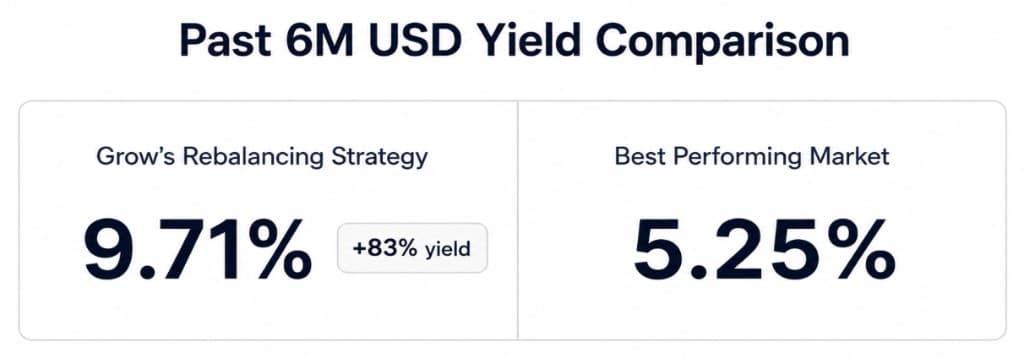
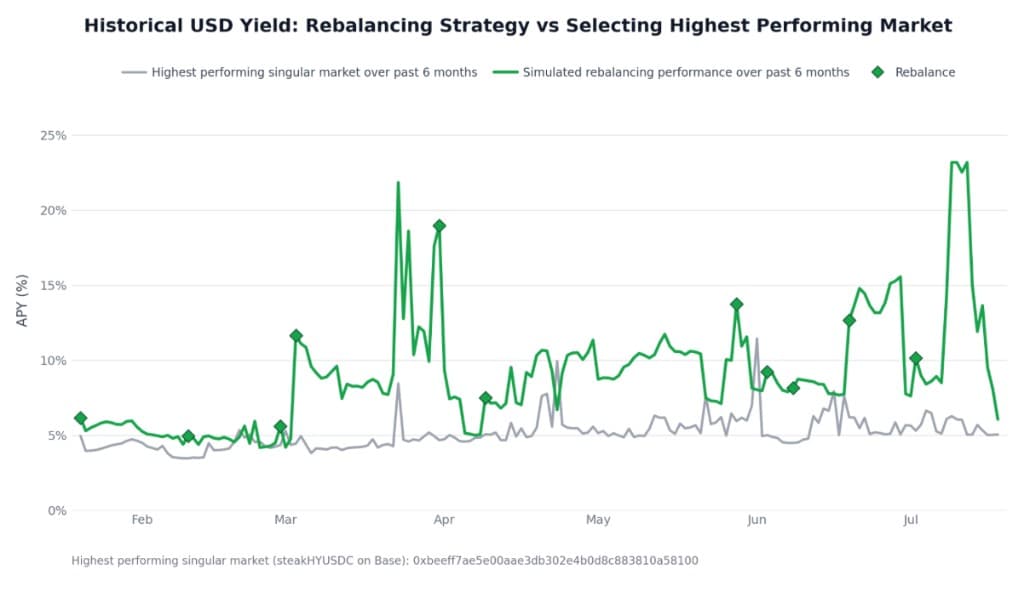
Over the past six months, Grow's USD rebalancing strategy generated a 9.71% annualized yield, 83% higher than the best-performing single lending market over the same period, while maintaining a similar risk profile.
Users don't have to trust Grow because the code restricts it to doing exactly one thing: moving supported assets between approved lending markets.
What is yield?
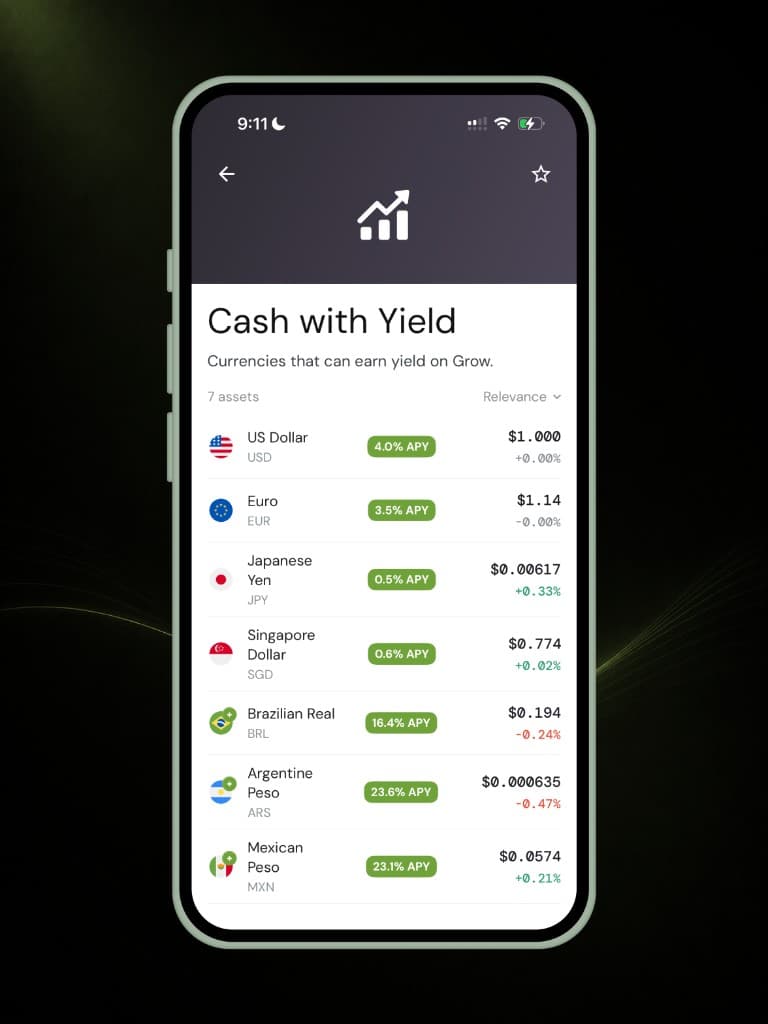
Grow offers yield on a range of assets, including U.S. dollars, local currencies and selected crypto assets.
When you enable Yield, your assets are supplied to lending markets. Borrowers post collateral to take out loans, and the interest they pay is distributed to lenders, including Grow users.
Unlike traditional banks, these markets are operated by smart contracts that automatically manage deposits, loans and interest rates. Anyone can earn yield simply by supplying capital.
Why active reallocation matters
Supplying assets to a lending market is easy. Finding the best one isn't.
There isn't one lending market. There are dozens of protocols, each containing numerous lending markets and vaults. Every market differs in its interest rates, liquidity, borrow demand, risk profile and temporary incentives.
These conditions are constantly changing. The best place to earn yield today may not be the best place tomorrow.
Many lending protocols also launch temporary incentive programs to attract deposits into new markets. During these periods, yields can increase substantially before gradually returning to normal as more liquidity arrives.
As a result, consistently maximizing risk-adjusted returns would require continuously monitoring dozens of markets and reallocating funds whenever a meaningfully better opportunity appears.
Most yield products solve this by taking custody of user funds and optimizing everything behind the scenes. Grow was built to provide the same automation while keeping users in control.
The chart below illustrates why Grow consistently outperformed the best-performing single lending market.
The obvious question is: how can Grow automate reallocations while users remain in control of their assets?
How Grow Yield Works
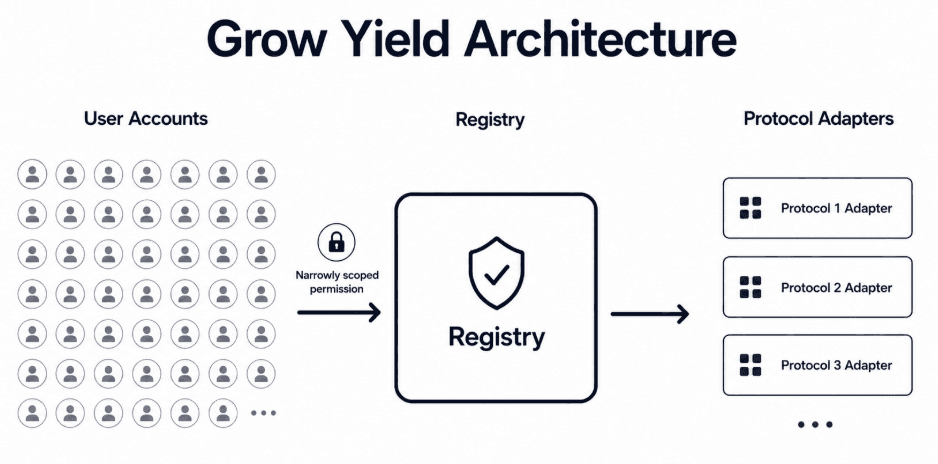
When a user has yield enabled, they grant Grow a narrowly scoped permission.
That permission allows Grow to do exactly one thing: move supported assets between approved lending markets in search of better yield.
It cannot transfer assets, buy investments, change account settings, install new permissions or execute arbitrary transactions.
Every automated transaction passes through four components:
- User Account: Defines Grow's permissions.
- Registry: Defines approved markets.
- Protocol Adapters: Verify protocol authenticity and execute protocol commands.
- Executor: Coordinates execution.
No component can bypass the others.
Adding a lending market
Grow currently supports four lending protocol families: Aave, Morpho, Euler and CapyFi. They are among the most established lending systems in decentralized finance, securing billions of dollars in assets.
Before a market can be added to the registry, it must satisfy two independent requirements.
First, it must pass the protocol's immutable validation logic. Every protocol has its own adapter that verifies the market is authentic—for example, confirming it was created by the protocol's canonical factory, belongs to the correct deployment and supports the expected asset.
Second, it must satisfy Grow's approval criteria.
For permissionless protocols such as Morpho and Euler, Grow evaluates every market against a published set of objective requirements covering areas such as liquidity, fees, governance and risk controls.
These requirements are published on Grow's website and updated in real time, allowing anyone to understand why a market was approved and independently review new additions.
Protocols such as Aave and CapyFi already maintain curated lending markets, so Grow relies on those permissioned listings rather than evaluating individual markets itself.
Only after both checks succeed is a market added to the onchain registry and made eligible for automatic allocation.
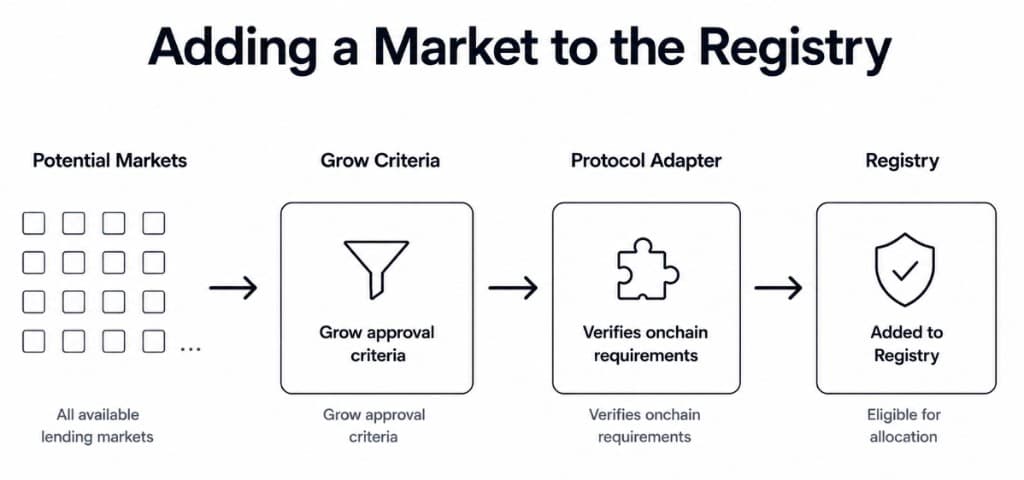
Every approved market is publicly visible in the registry, and every automated reallocation is recorded onchain.
Yield is also entirely optional. If a user isn't comfortable with Grow's market selection, they can disable Yield at any time. Their assets remain in their wallet, and no further reallocations occur until they re-enable it.
Processing a reallocation
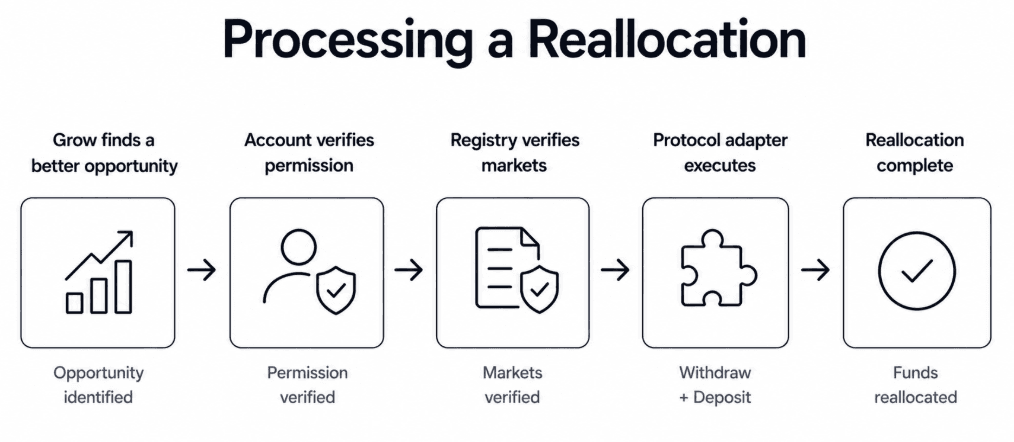
When Grow identifies a better opportunity, it submits a transaction using the user's existing permission.
Before any funds move:
- The User Account verifies Grow is performing an approved action.
- The Registry verifies both lending markets are approved.
- The appropriate Protocol Adapter performs the withdrawal and deposit.
If any check fails, the transaction reverts.
Assets cannot be redirected to another wallet, substituted for another asset or deposited into an unapproved market.
Immutable by design
The system is not upgradeable.
Grow cannot replace handlers, weaken validation rules or expand its permissions after deployment.
Supporting a new protocol requires deploying a new version that users must explicitly approve.
That means the permissions users grant today remain the permissions enforced tomorrow.
How Grow finds better yield
The architecture defines what Grow is allowed to do. The allocation engine determines when it should do it.
On a regular cadence, Grow evaluates every supported market for every supported asset across every supported protocol.
For each supported asset, Grow estimates the expected net return after considering:
- Current lending rates
- Lending rate history
- Temporary rewards and incentives
- Available liquidity
- Market utilization
- Protocol and market risk
- The cost of moving funds
Grow isn't simply chasing the highest advertised APY.
A market offering a higher rate may have limited liquidity, unusually high risk or incentives that are about to expire. Instead, Grow reallocates funds only when another approved market is expected to produce a meaningfully better return after accounting for those tradeoffs.
Because transaction costs are extremely low, Grow can reallocate whenever the expected improvement outweighs the cost of moving.
Built to find the best opportunities
The best opportunity won't always be on the same protocol or even the same blockchain.
By separating permissions, protocol validation and execution, Grow can integrate new lending protocols and financial products without changing its underlying security model.
As better opportunities emerge, Grow can integrate them while preserving the same narrowly scoped permissions users originally approved.
Users shouldn't need to know whether the best opportunity is on Aave, Morpho, Euler, or a protocol that hasn't been built yet. Grow's job is to continuously find the best approved opportunity while users remain in control of their assets.
Verify it yourself
The audited contracts powering Grow Yield are open source. You can inspect the source code and deployed contracts here.
We believe financial software should be transparent. Users shouldn't have to trust marketing claims. They should be able to verify how the system works themselves.
Financial software shouldn't require blind trust.
Grow's architecture makes its permissions explicit, publicly verifiable and intentionally narrow, allowing users to keep control of their assets while Grow continuously searches for better opportunities on their behalf.
That's the future we think financial software should move toward.
Ready to earn yield you control?
Enable Yield in Grow and keep your assets in your wallet at getgrowapp.co/join.
Join the public beta